A New Digital Tool Brings Data-Driven Biogas Planning to Agriculture
The HarvRESt project has taken a significant step forward with the launch of a digital planning tool aimed at strengthening biogas development across the agricultural sector. By combining farm-level data with advanced modelling, the tool offers a more reliable and efficient basis for decision-making, whether for public authorities, energy planners or farming communities.
From raw data to real decisions
At the heart of the tool is a comprehensive farm-level database that captures the key parameters needed to evaluate biomass availability, environmental impacts and the viability of available biomass. Where conventional approaches have long depended on aggregated figures or labour-intensive manual processing, this solution draws on continuously updated agricultural activity data to deliver fast, high-resolution analyses tailored to individual farms, municipalities or entire regions.
The shift from manual assessments to automated analytics is not merely a technical upgrade, it represents a meaningful change in how evidence-based planning can be carried out across the sector.
A tool that works at every scale
The planning tool, which has been developed by the Danish project partner Conterra, has been built to function across multiple levels. It integrates farm-specific activity data with established environmental and agronomic models to assess biogas potential, greenhouse gas emissions and nutrient cycling, from a single holding right through to regional or national scale.
In practical terms, this means stakeholders can estimate biomass availability and production potential, evaluate greenhouse gas balances, model different deployment scenarios and draw on solid data when making infrastructure or policy decisions. The tool is designed to be useful primarily to municipalities, energy developers, investors and advisory services, as well as farmers who supply to or receive from biogas facilities.
Tested and validated in Denmark
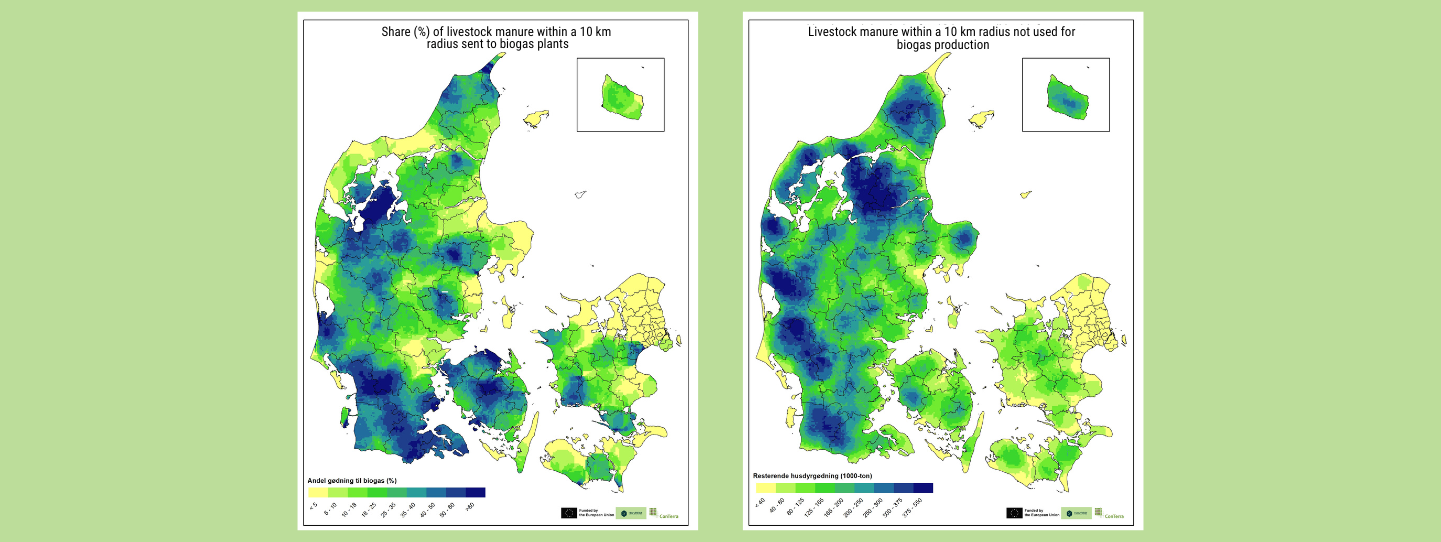
The Danish use case has been central to demonstrating the tool's real-world value. Applied to the strategic planning of manure-based biogas production, it draws on continuously updated datasets from agricultural registers and public sources to map biomass resources, quantify emission reductions, and assess nitrogen and phosphorus flows across farming systems.
Crucially, the emphasis is on long-term strategic planning rather than operational monitoring, an approach that aligns closely with Danish and broader European priorities around climate mitigation, renewable energy expansion and responsible nutrient management.
Filling a recognised gap in the market
The biogas planning tool addresses a well-documented gap in the availability of reliable, transparent and spatially explicit assessments of biomass potential and optimal plant siting.
By replacing slow, inconsistent manual procedures with rapid analyses grounded in updated activity data, the tool makes feasibility assessments more accurate and more accessible. This positions it as a particularly timely resource given the growing momentum behind European policy initiatives to scale up biomethane production and accelerate rural decarbonisation. Its primary users span public authorities, energy-sector organisations, agricultural advisory services and financial institutions.
Contributing to a greener farming sector
The tool's significance extends beyond its technical functions. By enabling better planning of biogas systems, it supports a broader set of goals: reducing agricultural greenhouse gas emissions, improving the utilisation of manure and organic residues, strengthening nutrient recycling within farming systems and boosting energy self-sufficiency in rural areas.
These outcomes sit at the core of HarvRESt's wider ambition, to integrate renewable energy systems into agriculture and support the transition towards climate-neutral farming across Europe.
Looking ahead
The biogas planning tool is also conceived as a building block for more advanced digital solutions within the project. Future development will focus on deeper integration with the Agricultural Virtual Power Plant (AVPP) concept, expanded scenario modelling across multiple renewable energy sources, and the potential to extend the approach to other European contexts as suitable data becomes available.
In time, the tool is expected to form part of a broader decision-support ecosystem capable of weighing complex trade-offs between energy production, agricultural productivity and environmental sustainability.
A foundation for scaling up
What the HarvRESt project has demonstrated, above all, is that digital innovation does not need to start from scratch. By working intelligently with existing data sources, it is possible to translate complex datasets into clear, actionable insights that allow stakeholders to move from planning to implementation with confidence.
Curious to learn more?
If you want to learn more about the digital planning tool or if you have any questions, you can reach out to Holger Nehmdahl, CEO at Conterra.